
How Cabinet Height and Proportion Affect the Way Your Kitchen Feels

Conflicting plans are not inevitable in remodeling. They result from fragmented structure.
Anthony Slabaugh Remodeling & Design provides design-build home renovation services for homeowners in Hudson, Akron & surrounding areas who value architectural alignment and disciplined execution.
Most homeowners evaluate kitchen cabinetry by color, door style, or finish. Far fewer consider one of the most influential factors in kitchen design: cabinet height and proportion.
Yet proportion shapes perception. It influences whether a kitchen feels balanced or compressed, refined or awkward, intentional or pieced together.
At Anthony Slabaugh Remodeling & Design, cabinet height is not treated as a default specification. It is evaluated as an architectural decision. Serving homeowners in Hudson, Akron & surrounding areas, our design-build process carefully aligns cabinetry proportions with ceiling height, room scale, and overall architectural character.
A kitchen does not simply function. It feels a certain way. And proportion plays a central role in that experience.
Why Cabinet Height Is More Than a Measurement
Standard cabinet heights exist for efficiency, but kitchens are not purely standardized spaces. Ceiling height varies from home to home, particularly in older properties throughout Hudson, Bath, and Chagrin Falls.
When cabinet height is selected without considering overall room proportion, subtle imbalances emerge:
- Cabinets may appear too short beneath tall ceilings
- Crown transitions can feel abrupt
- Vertical space becomes visually disconnected
- The kitchen may feel compressed despite adequate square footage
Proportion is the relationship between elements. Cabinet height influences how the eye moves through the space and how architectural lines align.
Design decisions that respect proportion create visual calm.
The Relationship Between Ceiling Height and Cabinetry
Ceiling height is one of the most important determinants of appropriate cabinet scale.
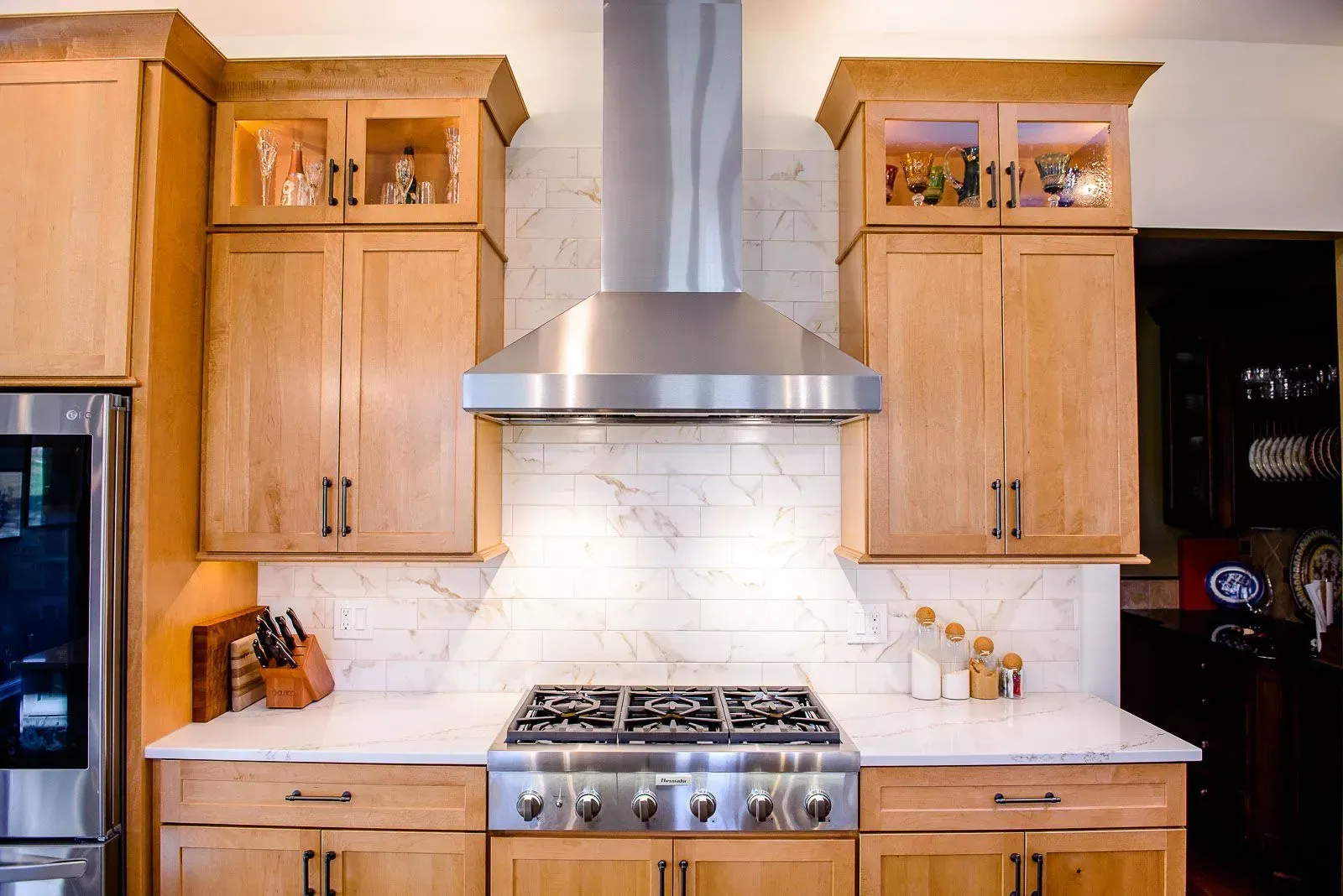
In kitchens with 8-foot ceilings, standard upper cabinets often leave a visible gap above. While this was once common practice, it can create a visual interruption that makes the room feel shorter. Extending cabinetry to the ceiling can create a cleaner vertical line and reinforce architectural continuity.
In kitchens with 9-foot or taller ceilings, proportion becomes even more critical. Cabinets that are too short can make the ceiling feel disconnected from the rest of the room. Conversely, cabinetry that is scaled properly maintains visual balance and avoids the appearance of floating elements.
At Anthony Slabaugh Remodeling & Design, we evaluate:
- Ceiling height
- Crown molding depth
- Window and door header alignment
- Vertical sightlines
- Lighting placement
These elements work together to determine appropriate cabinet height.
Visual Weight and Horizontal Balance
Cabinet height also affects visual weight.
When upper cabinets dominate a wall without proportionate balance from base cabinetry, range hoods, or windows, the kitchen can feel top-heavy. When upper cabinets are undersized relative to base cabinetry, the room can feel bottom-heavy.
Balanced proportion creates stability.
In many homes across Fairlawn, Aurora, and Pepper Pike, we encounter kitchens where previous renovations altered cabinetry without recalibrating vertical relationships. The result is not necessarily dramatic, but it subtly affects how the space feels.
Proportion influences emotional response.
Ceiling Transitions and Architectural Continuity
Kitchen cabinetry does not exist in isolation. It must relate to adjacent living spaces.
When kitchens open into family rooms or dining areas, abrupt changes in cabinet height can disrupt continuity. If ceiling heights vary between rooms, cabinetry must be carefully scaled to avoid visual breaks.
For example:
- A kitchen with 9-foot ceilings opening into an 8-foot dining area requires thoughtful transitions.
- Cabinet crown detailing should align with adjacent architectural trim.
- Window head heights should coordinate with cabinet tops when possible.
This level of alignment is rarely considered in surface-level renovations. It is central to architectural design.
For a broader look at our integrated process, visit our
Kitchen Remodeling
page.
Standard Heights vs. Customized Proportion
While standard cabinetry sizes provide efficiency, custom proportion allows precision.
There are instances where semi-custom solutions work well. However, in kitchens where ceiling height, beam depth, or window placement create unique conditions, custom cabinet sizing may be required to maintain visual alignment.
Custom cabinet height strategies may include:
- Stacked upper cabinets for tall ceilings
- Modified cabinet depths to adjust scale
- Integrated soffit removal for improved vertical flow
- Tailored crown transitions for seamless alignment
At
Anthony Slabaugh Remodeling & Design,
proportion is not accidental. It is engineered through coordinated planning.
The Psychological Impact of Proportion
Homeowners often describe well-proportioned kitchens as calm, grounded, or refined.
They may not consciously identify cabinet height as the cause. However, proportion shapes perception in subtle ways:
- Vertical alignment makes ceilings feel taller
- Balanced massing reduces visual clutter
- Consistent lines create rhythm
- Proper scaling enhances natural light distribution
By contrast, disproportionate cabinetry can make a kitchen feel slightly unsettled, even when finishes are high-end.
Architecture influences emotion.
Cabinet Height and Lighting Integration
Lighting placement is directly affected by cabinet height decisions.
Under-cabinet lighting must align with sightlines. Ceiling lighting must complement vertical cabinet proportions. When cabinetry extends to the ceiling, lighting strategy must adjust accordingly.
Coordinated design ensures:
- Even task lighting
- Balanced shadow lines
- Clean ceiling transitions
- Integrated trim and crown detailing
Mechanical and lighting systems should align with cabinetry decisions, not follow them reactively.
Evaluating Your Kitchen’s Proportion
When assessing cabinet height during a kitchen renovation, consider:
- Does the cabinet height relate well to the ceiling?
- Do upper cabinets feel compressed or disconnected?
- Is crown molding proportionate to the room?
- Do cabinets align visually with adjacent rooms?
- Does the kitchen feel vertically balanced?
These questions often reveal subtle proportion challenges that impact the overall experience of the space.
For homeowners exploring cabinetry upgrades without structural changes, our
Kitchen Renovation Services page provides additional insight.
Visit Our Design Studio in Stow, Ohio
Proportion is best evaluated in person. At Anthony Slabaugh Remodeling & Design, our design studio in Stow, Ohio allows homeowners to review cabinet heights, crown transitions, and vertical relationships within a curated architectural environment.
Serving Hudson, Akron & surrounding areas, we guide homeowners through a structured design-build process that aligns cabinet height, layout, lighting, and materials into a cohesive renovation strategy.
Architectural continuity begins with disciplined planning.
Frequently Asked Questions
Should kitchen cabinets always go to the ceiling?
Not always. The decision depends on ceiling height, architectural style, and proportion. Extending cabinets to the ceiling often improves continuity, but scaling must be evaluated carefully.
Does cabinet height affect resale value?
Well-proportioned cabinetry enhances perceived quality and architectural refinement, which can positively influence resale value.
Can cabinet height be adjusted without changing layout?
Yes. During a kitchen renovation, cabinet height can often be modified without altering the overall layout, provided structural conditions allow.
Is custom cabinetry required for proper proportion?
Not always. Semi-custom solutions may work in standard ceiling conditions. Custom sizing is beneficial when architectural alignment requires precision.
How do I know if my kitchen feels disproportionate?
If cabinets appear disconnected from the ceiling or visually unbalanced, proportion adjustments may improve the overall feel of the space.
Client Feedback on Our Kitchen Design Approach
Homeowners frequently note that their renovated kitchens feel more balanced and refined than expected. By carefully aligning cabinetry proportions with ceiling height and architectural context, Anthony Slabaugh Remodeling & Design creates kitchens that feel intentional rather than assembled. We invite you to read our Google reviews to learn more about their experiences.
Start With a Clear Plan
Proportion is not a finishing detail. It is a foundational design decision. Schedule a consultation with Anthony Slabaugh Remodeling & Design or call (330) 940-3237 to begin planning a kitchen renovation grounded in architectural balance.
Recent Posts


Share this article
CLIENT REVIEWS
Don’t Just Take Our Word For It
See below how our customers react on our ultimate pressure cleaning services