
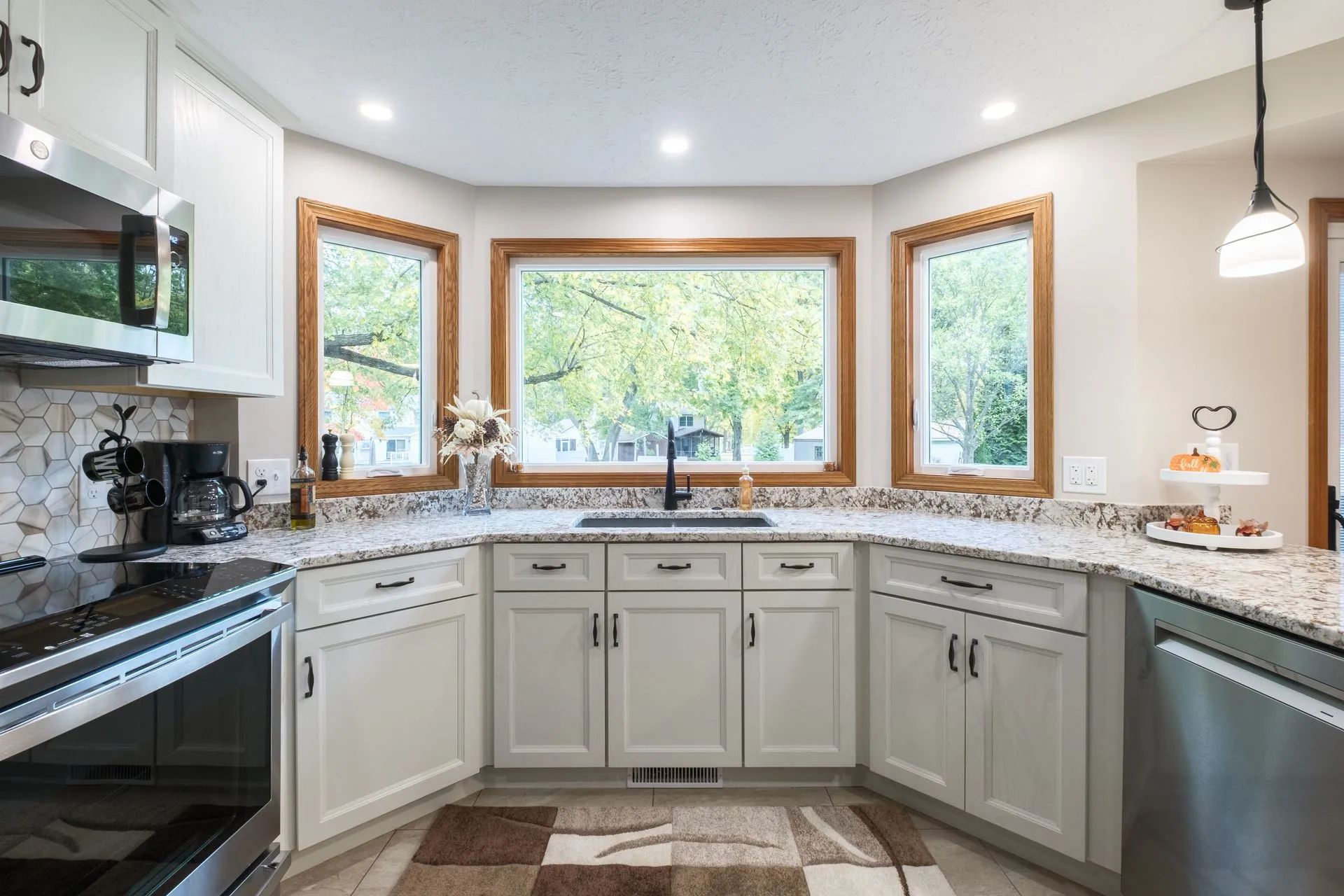
In many modern homes, the kitchen is no longer a secondary space. It is the center of daily life.
Meals are prepared, conversations unfold, guests gather, children do homework, and routines begin and end within this space. When designed intentionally, the kitchen becomes an architectural anchor that organizes the entire home.
A kitchen-centered floor plan does not simply enlarge the kitchen. It redefines how adjacent spaces relate to one another.
In Hudson, Akron & surrounding areas, homeowners pursuing custom design increasingly choose layouts that position the kitchen as the spatial and social core of the home.
Hierarchy begins with placement.
The Kitchen as Architectural Anchor
In traditional layouts, kitchens were often enclosed or positioned at the rear of the home. Circulation wrapped around them rather than through them.
In a kitchen-centered floor plan, the kitchen becomes the pivot point for movement and connection.
Primary gathering areas align with it. Circulation pathways radiate from it. Sightlines extend beyond it.
This planning approach reshapes the home’s internal rhythm.
How Centered Planning Improves Circulation
When the kitchen is positioned strategically within the layout:
- Movement between living, dining, and outdoor spaces becomes seamless
- Secondary rooms connect logically
- Congestion at entry points is reduced
- Visual flow supports social interaction
Circulation becomes intuitive rather than fragmented.
This is not about removing walls indiscriminately. It is about aligning pathways with lifestyle patterns.
In established communities such as Bath and Chagrin Falls, many homes were not originally designed with this centrality in mind. Custom planning allows the kitchen to assume a more integrated role while preserving architectural character.
Strengthening Spatial Hierarchy
A kitchen-centered floor plan also clarifies spatial hierarchy.
Public spaces flow outward from the kitchen. Private spaces branch away from it. Transitional areas support movement between zones.
When hierarchy is clear:
- The home feels organized
- Gathering areas feel intentional
- Private spaces feel protected
- Outdoor integration feels seamless
The layout reads cohesively.
Planning Variables in Kitchen-Centered Design
| Design Element | Planning Consideration | Impact on Layout |
|---|---|---|
| Kitchen placement | Central alignment within floor plan | Balanced circulation |
| Opening scale | Coordinated with adjacent spaces | Visual cohesion |
| Structural span | Supports open gathering areas | Proportional continuity |
| Outdoor connection | Aligns interior-exterior flow | Expanded living experience |
| Vertical relationship | Aligns ceiling height and volume | Spatial balance |
Each decision influences the home beyond the kitchen itself.
Integrating Structure and Lifestyle
Kitchen-centered planning often requires structural recalibration.
Load-bearing walls may need modification. Ceiling planes may be realigned. Structural spans may be extended to create openness without disrupting proportion.
Within an integrated design-build framework, these adjustments are studied alongside circulation and lifestyle analysis.
Anthony Slabaugh Remodeling & Design approaches kitchen-centered floor plan development with architectural clarity and structural awareness from the beginning.
For more insight into our approach, visit our Custom Home Design Services page.
You may also find our article on Lifestyle-Based Home Design helpful for understanding how daily routines influence spatial hierarchy.
Client Feedback on Our Design Process
Homeowners often remark that re-centering their layout around the kitchen transformed more than a single room. By aligning circulation and gathering spaces intentionally, the entire home feels more connected and functional. We invite you to read our Google reviews to learn more about their experiences.
Frequently Asked Questions
What is a kitchen-centered floor plan?
It is a layout strategy that positions the kitchen as the central hub of circulation and gathering within the home.
Does a kitchen-centered design require removing walls?
Not always. Strategic reconfiguration and proportional alignment often achieve integration without excessive demolition.
Is this approach only for large homes?
No. Even modest layouts benefit from clarifying spatial hierarchy around the kitchen.
Can older homes be adapted to a kitchen-centered layout?
Yes. Structural and architectural planning can recalibrate flow while respecting original character.
When should kitchen placement be determined in custom design?
During early architectural planning, before structural framing and circulation pathways are finalized.
Designing Around the Way Life Happens
When thoughtfully positioned, the kitchen does more than serve meals. It organizes movement, supports gathering, and anchors the entire home.
Anthony Slabaugh Remodeling & Design works with homeowners in Hudson, Akron & surrounding areas to create kitchen-centered floor plans that improve circulation, proportion, and overall layout clarity.
If you are planning a custom home or major renovation and want the heart of the home to guide the architecture around it, begin with a design conversation grounded in spatial hierarchy and coordinated planning.