

Storage Ideas for Basement Home Gym Equipment, Mats, and Accessories

Conflicting plans are not inevitable in remodeling. They result from fragmented structure.
Anthony Slabaugh Remodeling & Design provides design-build home renovation services for homeowners in Hudson, Akron & surrounding areas who value architectural alignment and disciplined execution.
A basement home gym should feel focused, organized, and easy to use. Even a well-planned workout room can feel cluttered if mats, bands, free weights, towels, shoes, foam rollers, and accessories do not have a dedicated place.
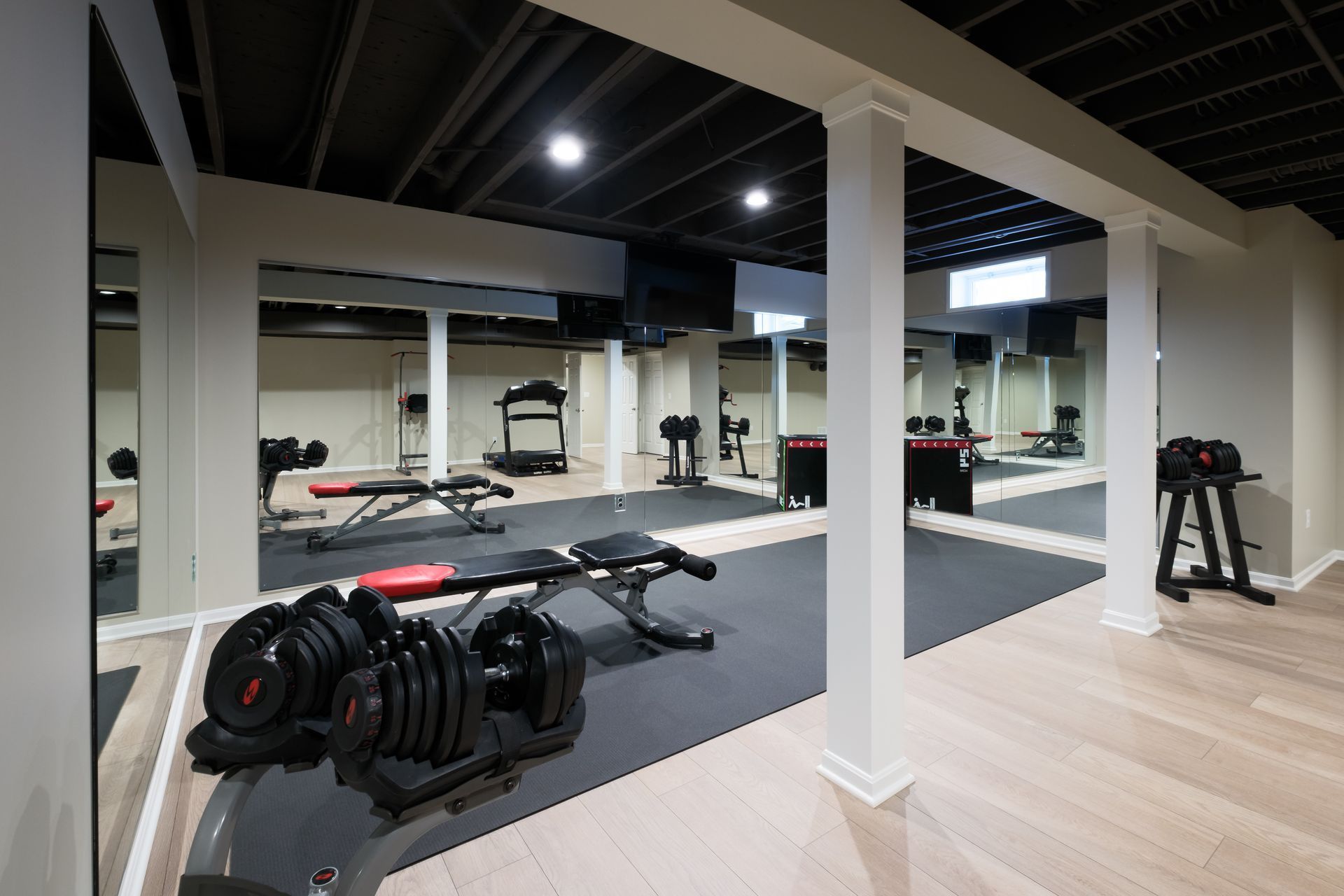
The best basement home gym storage ideas support daily workouts without making the room feel crowded. Storage should be close to the activity, strong enough for equipment, easy to access, and refined enough to fit the finished lower level.
At
Anthony Slabaugh Remodeling & Design, we help homeowners in Hudson, Akron and surrounding areas design basement home gyms with storage, layout, lighting, flooring, and finish details planned together.
Start With What Needs to Be Stored
Before adding shelving or cabinets, identify what the gym needs to hold. Free weights, kettlebells, resistance bands, yoga mats, towels, shoes, cleaning supplies, jump ropes, recovery tools, and small accessories all require different storage solutions.
A strength-focused gym may need durable free weight storage. A yoga or mobility space may need mat storage and open floor space. A cardio room may need space for towels, shoes, headphones, and cleaning supplies.
For homeowners throughout Bath, Fairlawn, and Chagrin Falls, this early planning helps the basement gym feel custom rather than improvised.
Keep Storage Close to Each Workout Zone
Home gym storage works best when it is placed near the activity it supports. Mats should be near stretching areas. Weights should be near strength zones. Towels and cleaning supplies should be easy to reach near cardio equipment.
When storage is placed too far away, accessories often end up on the floor, on benches, or in corners. A thoughtful layout keeps items accessible without interrupting movement.
At
Anthony Slabaugh Remodeling & Design, storage is planned with the gym layout so the space feels organized during and after workouts.
Use Wall Storage With Restraint
Wall systems can be helpful for bands, mats, jump ropes, and light accessories. They keep items visible and easy to reach while preserving floor space.
However, too much wall storage can make a finished basement gym feel busy or overly utilitarian. A premium fitness room should balance open access with visual calm. Some items belong on hooks or racks, while others are better hidden in cabinets or drawers.
The right mix depends on how often each item is used.
Plan Free Weight Storage Carefully
Free weight storage needs more structure than general shelving. Dumbbells, kettlebells, plates, and bars can be heavy, awkward, and visually dominant. Storage should be stable, accessible, and placed where weight training actually happens.
A strength zone may include a dedicated rack, reinforced storage area, or built-in cabinet system designed around the equipment. Clear floor space around the weight area is also important for safe movement.
Storage should support the workout instead of crowding it.
Basement Home Gym Storage Guide
| Storage Need | Best Planning Approach |
|---|---|
| Free weights | Use stable racks or designated strength-zone storage |
| Yoga mats | Store vertically or in a nearby cabinet or wall system |
| Bands and ropes | Keep accessible with hooks, drawers, or organized wall storage |
| Towels and supplies | Use closed cabinets or shelves near cardio zones |
| Recovery tools | Store near stretching or mobility areas |
| Cleaning items | Keep hidden but easy to reach for daily maintenance |
This table is useful because gym storage should be planned around the item type, workout zone, and how visible the storage should be.
Use Closed Cabinets for Visual Calm
Not every item should be visible. Closed cabinets can hide towels, shoes, cleaning products, extra accessories, and less frequently used equipment. They also help the gym feel more connected to the rest of the finished basement.
Cabinetry can be especially useful if the gym is visible from a family room, media space, hallway, or home office. A clean storage wall can make the fitness room feel polished even when it is used daily.
Protect Circulation and Open Floor Space
A basement home gym needs open space for movement. Storage should never block workout zones, doors, mirrors, vents, electrical panels, or walkways.
This is especially important in smaller gyms where every wall and corner matters. Storage should make the room easier to use, not make it feel tighter.
Good storage planning supports both organization and movement.
Coordinate Storage With Lighting, Mirrors, and Finishes
Storage should be planned with the full room design. A mirror wall may not be the right place for hooks. A storage cabinet may need lighting nearby. Flooring should support both equipment and frequent movement. Hardware, cabinetry, wall color, and trim should feel coordinated.
When storage, mirrors, lighting, and finishes work together, the gym feels custom instead of assembled one piece at a time.
Visit Our Design Studio in Stow, Ohio
Our Stow, Ohio design studio gives homeowners a place to review cabinetry, storage options, flooring, lighting, hardware, mirrors, and finish selections together. Seeing these details in context helps clarify how a basement gym can stay organized without losing its refined feel.
Client Feedback on Our Remodeling Process
Homeowners often share that early planning helps them feel more confident about specialized spaces like basement gyms. By reviewing storage, equipment needs, workout zones, mirrors, lighting, flooring, and finishes together,
Anthony Slabaugh Remodeling & Design helps clients make decisions with clarity instead of pressure.
Frequently Asked Questions
What are the best basement home gym storage ideas?
The best basement home gym storage ideas depend on the equipment. Free weights may need stable racks, while mats, bands, towels, and recovery tools may work better in cabinets, drawers, hooks, or organized wall systems near each workout zone.
How do you store free weights in a basement gym?
Free weights should be stored in a stable, accessible area near the strength zone. Dumbbells, plates, kettlebells, and bars should not block circulation, mirrors, doors, or floor space needed for safe movement.
How do you keep a home gym from looking cluttered?
Use a mix of visible and hidden storage. Frequently used items can stay accessible, while towels, cleaning supplies, shoes, and extra accessories can be kept in closed cabinets or drawers for a cleaner finished look.
Where should yoga mats and accessories be stored?
Yoga mats, bands, foam rollers, and stretching accessories should be stored near the mobility or stretching zone. Vertical storage, cabinets, hooks, or shelves can keep them easy to reach without taking over open floor space.
Start With Gym Storage Designed Around Daily Use
A refined basement home gym should make equipment, mats, and accessories easy to use while keeping the space calm and organized. Schedule a consultation with Anthony Slabaugh Remodeling & Design or call (330) 940-3237 to plan your basement home gym with confidence.
Recent Posts
Share this article
CLIENT REVIEWS
Don’t Just Take Our Word For It
See below how our customers react on our ultimate pressure cleaning services