
How Ceiling Height Influences Lighting Design and Fixture Selection

Conflicting plans are not inevitable in remodeling. They result from fragmented structure. 


Anthony Slabaugh Remodeling & Design provides design-build home renovation services for homeowners in Hudson, Akron & surrounding areas who value architectural alignment and disciplined execution. 


If you are planning a renovation and want drawings that translate directly into construction without conflict, begin with a unified design-build model designed to eliminate misalignment before it begins.

Lighting design is not only about fixture style or placement. It is directly shaped by the volume of the space. Ceiling height plays a critical role in how light is distributed, how fixtures are selected, and how the kitchen ultimately feels.


In high-end kitchen remodeling, lighting must respond to scale. A solution that works in a standard ceiling height may fall short in a vaulted space, while oversized fixtures can overwhelm a lower ceiling.

At Anthony Slabaugh Remodeling & Design, we design kitchens for homeowners in Hudson, Akron and surrounding areas where lighting is tailored to the architecture of the home. Ceiling height is one of the first factors we evaluate when developing a lighting plan.


The volume of the room determines how light should behave.

Why Ceiling Height Matters in Kitchen Lighting

Ceiling height affects how far light travels, how evenly it spreads, and how fixtures are perceived within the space. As ceiling height increases, light must cover a larger vertical distance before reaching work surfaces.


  • Without proper planning, this can result in:
  • Dim or uneven illumination 
  • Excessive shadows on countertops 
  • Fixtures that appear too small or out of scale 
  • Light that fails to reach key work zones 


In homes throughout Bath, Fairlawn, and Chagrin Falls, ceiling heights often vary between rooms. Kitchens may feature standard ceilings, raised ceilings, or vaulted designs. Each condition requires a different lighting approach.


Lighting should adapt to the space, not follow a single standard.

Lighting Design for Standard 8-Foot Ceilings

In kitchens with standard ceiling heights, lighting can be more compact and controlled. Fixtures are closer to the work surface, allowing for efficient illumination with moderate output.

Key considerations for 8-foot ceilings include:


  • Recessed lighting placed with precise alignment to cabinetry 
  • Moderate lumen output to avoid excessive brightness 
  • Pendant fixtures sized appropriately for lower ceiling height 
  • Proper spacing to maintain even coverage 


Pendant stem length is particularly important. Fixtures must hang low enough to provide focused light without obstructing sightlines.


In homes throughout Hudson and Aurora, many kitchens still feature standard ceiling heights. In these spaces, restraint and precision are key.


Proportion defines comfort.

Lighting Design for 9 to 10-Foot Ceilings

Slightly taller ceilings introduce additional flexibility but also require adjustments in lighting strategy. Light must travel farther, and fixture scale becomes more noticeable.


In these kitchens, we often incorporate:


  • Increased lumen output to maintain brightness 
  • Slightly larger or more prominent pendant fixtures 
  • Adjusted recessed lighting spacing 
  • Layered lighting to ensure full coverage 


This range is common in many updated homes throughout the area, where kitchens are designed to feel more open while maintaining a comfortable scale.


Balance between brightness and proportion becomes more important as ceiling height increases.

Lighting Design for Vaulted and High Ceilings

Vaulted ceilings and large open spaces present a different set of challenges. Light must travel a greater distance, and fixture placement must account for both vertical and horizontal scale.


Without proper planning, high ceilings can result in:


  • Insufficient light at countertop level 
  • Overreliance on a single lighting layer 
  • Fixtures that feel visually disconnected from the space 


To address this, lighting design often includes:


  • Higher lumen output fixtures to ensure adequate brightness 
  • Larger pendant lights that match the scale of the room 
  • Additional layers of lighting to support different zones 
  • Strategic placement to avoid dark areas 


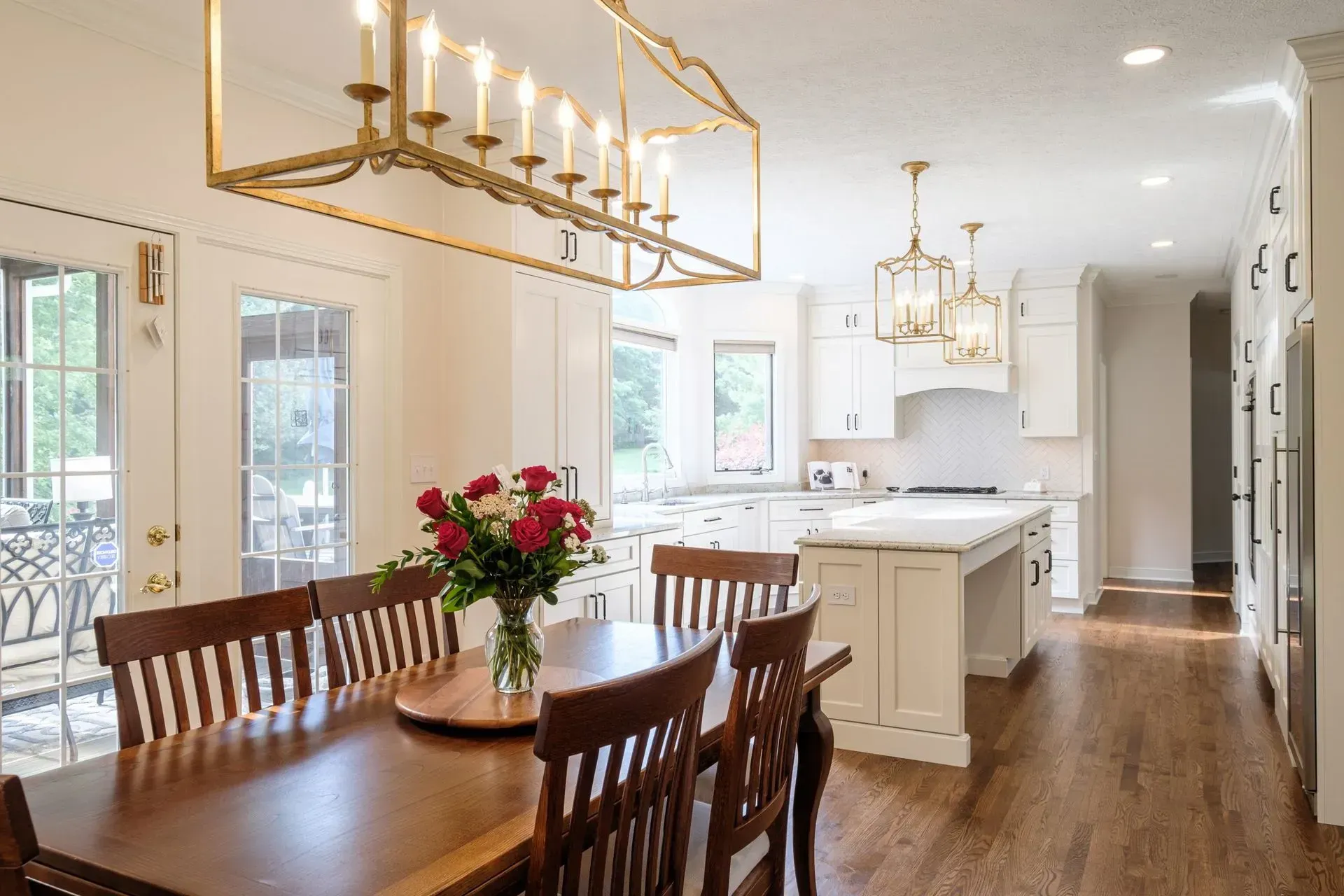
In homes throughout Pepper Pike and Hunting Valley, vaulted kitchens require a more advanced approach to lighting design. Fixture size, placement, and output must all be carefully coordinated.


Scale demands intentional design.

Understanding Lumen Output and Light Performance

Lumen output measures the total amount of light produced by a fixture. As ceiling height increases, higher lumen output is required to maintain effective illumination.


In lower ceilings, excessive lumen output can create glare. In higher ceilings, insufficient output can leave work areas underlit.


Proper planning ensures:

  • Adequate brightness across all work zones 
  • Even distribution of light throughout the kitchen 
  • Comfort without harsh or overly intense lighting 


At Anthony Slabaugh Remodeling & Design, we calibrate lighting output based on ceiling height, layout, and material selection.


Performance depends on correct scaling.

Fixture Scale and Visual Proportion

Ceiling height also affects how fixtures are perceived visually. A fixture that feels appropriately sized in a standard kitchen may appear too small in a vaulted space.


Key considerations include:


  • Pendant size relative to island dimensions 
  • Fixture scale in relation to ceiling height 
  • Spacing between fixtures for visual balance 
  • Alignment with architectural features 


In high-end kitchens, fixture selection is not only functional but also part of the overall design composition.


Proportion creates visual harmony.

Stem Length and Hanging Height

Pendant lighting must be adjusted based on ceiling height to ensure proper positioning above the island or work surface.


For standard ceilings:


  • Pendants are hung lower to provide focused light 
  • Stem length is shorter to maintain proportion 


For higher ceilings:


  • Longer stems or adjustable rods are used 
  • Fixtures are positioned to maintain proper distance from the countertop 
  • Visual balance is maintained within the larger vertical space


Incorrect hanging height can disrupt both function and design. Placement should feel intentional from every angle.

Layering Light Across Different Heights

Regardless of ceiling height, layered lighting remains essential. Combining ambient, task, and accent lighting ensures that all areas of the kitchen are properly illuminated.


In taller spaces, layering becomes even more important to avoid uneven brightness.


A well-layered lighting plan includes:


  • Recessed lighting for overall illumination 
  • Pendant lighting for focal areas 
  • Under-cabinet lighting for task zones 
  • Accent lighting to highlight materials 


Each layer works together to create a balanced environment. Depth in lighting creates depth in design.

The Role of Design-Build Coordination

Lighting design must be coordinated with architecture, cabinetry, and electrical planning. Ceiling height influences all of these elements, making early planning essential.


At Anthony Slabaugh Remodeling & Design, our design-build process ensures:


  • Lighting plans are developed alongside layout and cabinetry 
  • Electrical rough-ins are aligned with fixture placement
  • Fixture selection matches the scale of the space
  • The final result reflects the intended design


Coordination ensures that lighting performs correctly and enhances the overall kitchen. Process defines outcome.

Visit Our Design Studio in Stow, Ohio

Lighting design is best evaluated in relation to the full space. At Anthony Slabaugh Remodeling & Design, our Stow, Ohio design studio allows homeowners from Hudson, Akron and surrounding areas to explore lighting strategies based on ceiling height, layout, and material selection.


We help clients understand how scale, proportion, and lighting work together.


Seeing the relationship leads to better decisions.

Frequently Asked Questions    

  • How does ceiling height affect kitchen lighting?

    It influences how light spreads, how bright fixtures need to be, and how large fixtures should appear.

  • Do higher ceilings require brighter lights?

    Yes. Higher ceilings often require increased lumen output to maintain proper illumination.

  • How low should pendant lights hang?

    This depends on ceiling height, but pendants should provide focused light without blocking views or movement.

  • Can the same lighting be used for all ceiling heights?

    No. Lighting must be adjusted based on the scale and layout of the space.

  • When should lighting be planned in relation to ceiling height?

    Lighting should be planned early in the design phase along with layout and structural considerations.

Start With a Clear Plan

Lighting should reflect the scale of your space and support how your kitchen is used. Schedule a consultation with Anthony Slabaugh Remodeling & Design or call (330) 940-3237 to design a kitchen where lighting, architecture, and proportion are fully aligned.

Recent Posts

Guest Bathroom Design That Balances Durability and Long-Term Style
By Anthony Slabaugh Remodeling and Design April 6, 2026
Learn how to design a durable guest bathroom with high-performance materials that maintain long-term quality in homes across Hudson, Akron and surrounding areas.
Bathroom Layout Spacing Guide for Comfort and Function
By Anthony Slabaugh Remodeling and Design April 6, 2026
Learn how proper spacing between fixtures improves comfort, movement, and layout design in bathrooms across Hudson, Akron and surrounding areas.
By Anthony Slabaugh Remodeling and Design April 6, 2026
Tile is often selected based on color or pattern, but in smaller bathrooms, scale and layout play a more important role. The way tile is sized and arranged can significantly influence how the space feels.  In compact guest bathrooms, poor tile selection can create visual fragmentation. Excessive grout lines, inconsistent patterns, and improper scale can make the room feel smaller than it is. At Anthony Slabaugh Remodeling & Design , we design guest bathrooms in Hudson, Akron and surrounding areas with a focus on proportion and layout. Tile is not just a finish. It is part of the spatial structure. Scale defines perception.
Shower Drain Placement Guide for Tile Layout and Performance
By Anthony Slabaugh Remodeling and Design April 6, 2026
Learn how drain placement affects tile layout, slope, and long-term maintenance in showers across Hudson, Akron and surrounding areas.
Guest Bathroom Design That Balances Durability and Long-Term Style
By Anthony Slabaugh Remodeling and Design April 6, 2026
Learn how to design a durable guest bathroom with high-performance materials that maintain long-term quality in homes across Hudson, Akron and surrounding areas.
Bathroom Layout Spacing Guide for Comfort and Function
By Anthony Slabaugh Remodeling and Design April 6, 2026
Learn how proper spacing between fixtures improves comfort, movement, and layout design in bathrooms across Hudson, Akron and surrounding areas.
By Anthony Slabaugh Remodeling and Design April 6, 2026
Tile is often selected based on color or pattern, but in smaller bathrooms, scale and layout play a more important role. The way tile is sized and arranged can significantly influence how the space feels.  In compact guest bathrooms, poor tile selection can create visual fragmentation. Excessive grout lines, inconsistent patterns, and improper scale can make the room feel smaller than it is. At Anthony Slabaugh Remodeling & Design , we design guest bathrooms in Hudson, Akron and surrounding areas with a focus on proportion and layout. Tile is not just a finish. It is part of the spatial structure. Scale defines perception.

Share this article

CLIENT REVIEWS

Don’t Just Take Our Word For It

See below how our customers react on our ultimate pressure cleaning services