
Open-concept living transformed residential design. Walls came down. Kitchens connected to gathering areas. Formal rooms dissolved into larger shared spaces.
Yet as homes became more open, a new challenge emerged.
Without intentional spatial organization, openness can feel undefined. Rooms may appear expansive but lack purpose. Movement overlaps. Noise travels. Furniture competes with circulation.
Micro-zoning addresses this complexity.
In Hudson, Akron & surrounding areas, high-end remodeling increasingly relies on micro-zoning home design to create subtle spatial definition within open or semi-open layouts. The goal is not to divide rooms with walls, but to define purpose through architecture.
Structure remains. Function becomes refined.
What Is Micro-Zoning in Home Design?
Micro-zoning is the intentional subdivision of larger spaces into functional sub-areas without fully enclosing them.
Instead of creating separate rooms, designers establish:
- Defined activity zones
- Visual boundaries
- Layered transitions
- Controlled circulation paths
- Purpose-driven furniture placement
These zones operate cohesively while maintaining openness.
Micro-zoning transforms open layouts from expansive voids into orchestrated environments.
Why Modern Homes Require More Than Open Floor Plans
Open layouts improve sightlines and social interaction. However, without zoning discipline, they can create:
- Competing focal points
- Congested traffic paths
- Overlapping noise zones
- Undefined furniture placement
- Visual imbalance
In established communities such as Bath and Chagrin Falls, many homes are being remodeled to modernize layouts while preserving architectural integrity. Simply removing walls is no longer sufficient.
Advanced space planning requires internal organization.
Micro-zoning provides that structure.
How Designers Create Micro-Zones
Micro-zoning relies on architectural and spatial tools rather than partitions.
Common strategies include:
- Ceiling plane variation
- Lighting differentiation
- Flooring transitions
- Partial-height walls
- Built-in cabinetry
- Subtle level changes
- Structural beam placement
- Furniture alignment relative to circulation loops
These elements establish invisible boundaries.
Purpose becomes clear without enclosure.
Micro-Zoning in Practice
| Zoning Technique | Design Function | Architectural Outcome |
|---|---|---|
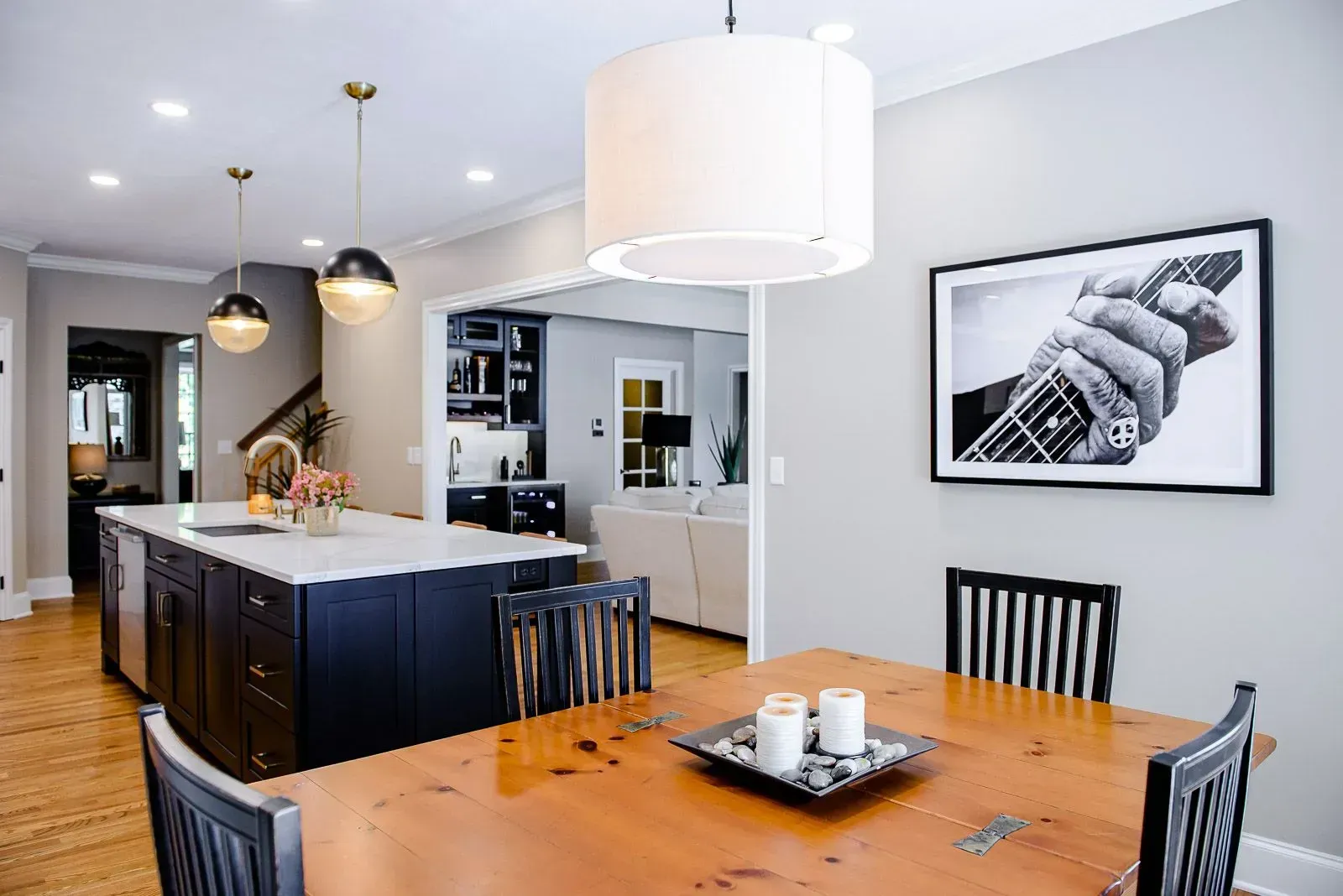
| Ceiling differentiation | Separate dining from living | Subtle vertical definition |
| Island orientation | Anchor kitchen activity | Directed circulation |
| Built-in shelving | Create reading alcove | Defined retreat space |
| Lighting layers | Highlight activity zones | Visual hierarchy |
| Structural framing alignment | Reinforce boundaries | Balanced spatial rhythm |
When coordinated early, these techniques create layered environments within a unified layout.
The Relationship Between Micro-Zoning and Circulation
Micro-zoning must align with circulation planning.
Primary pathways should flow around zones, not through them. Secondary movement routes must not disrupt focal areas.
For example, a reading niche should not interrupt kitchen-to-living traffic. A dining zone should not conflict with entry circulation.
Anthony Slabaugh Remodeling & Design integrates micro-zoning home design into our Space Planning & Layout Design process, ensuring movement patterns and zone definition are coordinated from the beginning.
You may also find our article on Circulation Loop Design helpful for understanding how flow and zoning intersect.
Structural and Lighting Integration
Micro-zoning is not purely decorative.
Structural beam placement can subtly define zones. Ceiling height variation reinforces hierarchy. Lighting temperature and intensity distinguish activity without visible partitions.
In many Hudson and Akron remodels, especially those involving structural reconfiguration, micro-zoning allows openness while maintaining order.
This level of refinement requires early planning.
For more insight into our planning methodology, visit our Space Planning & Layout Design page.
The Emotional Impact of Defined Openness
Homes designed with micro-zoning feel composed.
Gathering areas feel intentional rather than scattered. Workspaces feel purposeful without isolation. Conversation zones feel comfortable without enclosure.
The result is balance.
High-end remodeling increasingly prioritizes these subtle spatial refinements over square footage expansion.
Micro-zoning elevates experience.
Frequently Asked Questions
Is micro-zoning the same as adding partitions?
No. Micro-zoning defines space through architectural and spatial cues rather than full walls.
Does micro-zoning work in smaller homes?
Yes. It can enhance clarity and function without reducing openness.
Can micro-zoning be added during remodeling?
Yes. It is often integrated during structural and layout reconfiguration.
Does micro-zoning require ceiling changes?
Not always, but ceiling variation can strengthen zone definition.
When should zoning be planned?
During early space planning before structural and finish decisions are finalized.
Client Feedback on Our Planning Process
Homeowners frequently note that after remodeling, their open spaces feel organized rather than expansive without direction. By integrating micro-zoning strategies into architectural planning, we create homes that balance openness with clarity. We invite you to read our Google reviews to learn more about their experiences.
Designing Openness With Purpose
Modern homes require more than removed walls. They require refined internal organization.
Anthony Slabaugh Remodeling & Design works with homeowners in Hudson, Akron & surrounding areas to integrate micro-zoning home design into architectural space planning that prioritizes clarity, flow, and structural alignment.
If you are planning a remodel and want your open layout to feel intentional and composed, begin with a design conversation grounded in spatial precision.